

June 12, 2026
Energy prices rising again – up by 20% in Poland
After a record‑favourable April, the European energy market has clearly accelerated. In May, electricity prices on the short‑term market rose significantly – both in Poland (+20% month‑on‑month) and across Europe (+16.1% month‑on‑month) – mainly due to weaker renewable energy generation and tensions in commodity markets. Rising CO₂ emission allowance prices, geopolitical uncertainty in the gas market, and a deepening deficit in the oil market are creating a mix of factors that may continue to exert upward pressure on energy prices in the coming months.
The map of average energy prices was prepared by Energy Solution experts: Krzysztof Mazurski, Head of Portfolio Management, and Wojciech Listoś, Wholesale Energy and Gas Market Analyst.
Key informations:
- Energy prices in Europe are rising: the average day-ahead market price reached EUR 91.12/MWh (+16.1% m/m), driven by worsening weather conditions and lower wind generation. In Poland, the increase was as high as 20% m/m.
- BASE futures market also up: the 2027 contract increased by 2.5% m/m, mainly driven by rising EUA prices.
- CO₂ emission allowances: a 9.3% m/m increase in allowance prices and political tensions around reform of the system are reinforcing cost pressure.
- Gas still influenced by geopolitics: tensions in the Middle East and constraints in LNG supply are maintaining price uncertainty, although the EU currently does not see a risk of shortages in winter.
- Coal market: Prices are rising due to increased demand (mainly from China) and export restrictions in Indonesia.
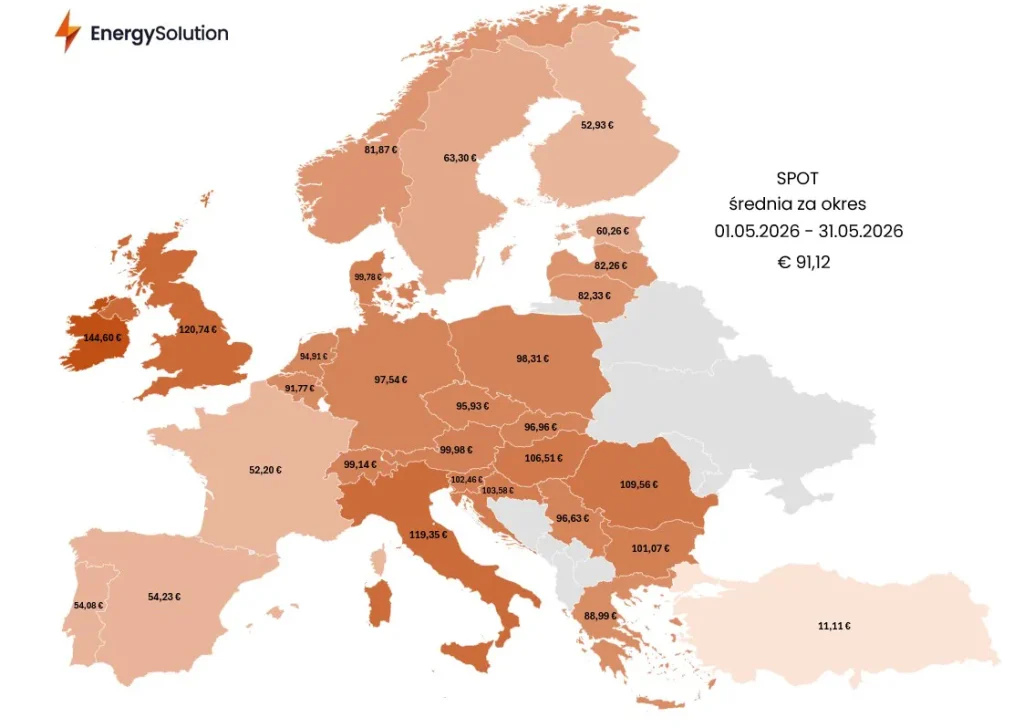
Fig. 1: Average SPOT price in May 2026
The average day-ahead market price for the entire analyzed area reached EUR 91.12/MWh in May, which was higher by EUR 12.62/MWh (16.1%) compared to the previous month. Following an exceptionally strong April, prices increased as a result of worsening weather conditions—especially in the second half of May. Electricity demand remained at similar levels; however, a decline in generation from renewable energy sources (particularly wind) contributed to the price rise.
The Polish market saw an increase of EUR 16.36/MWh (20%) month-on-month, indicating a stronger growth dynamic compared to the European average. Fortunately, prices in Poland—unlike in eight other countries—did not exceed the psychological threshold of EUR 100/MWh. On the one hand, there was a 17% year-on-year increase in photovoltaic generation in the domestic system; on the other hand, wind generation declined by 16% year-on-year.
The increase in prices was largely driven by a reversal in the trend related to cross-border trade. May was the second consecutive month this year in which Poland was a net exporter of electricity. This is due to the fact that previously the country more often imported cheaper energy from abroad, whereas now it is Poland’s neighbors that more frequently purchase electricity from Poland.
Their systems are more heavily reliant on gas-fired power plants, whose position in the merit order is significantly more expensive due to higher gas prices since the outbreak of the conflict in the Middle East.
For comparison, in 2025 Poland was a net exporter of electricity in only one month (June), whereas in 2024 there was not a single such month. If natural gas prices remain elevated, this trend may persist in the near term.
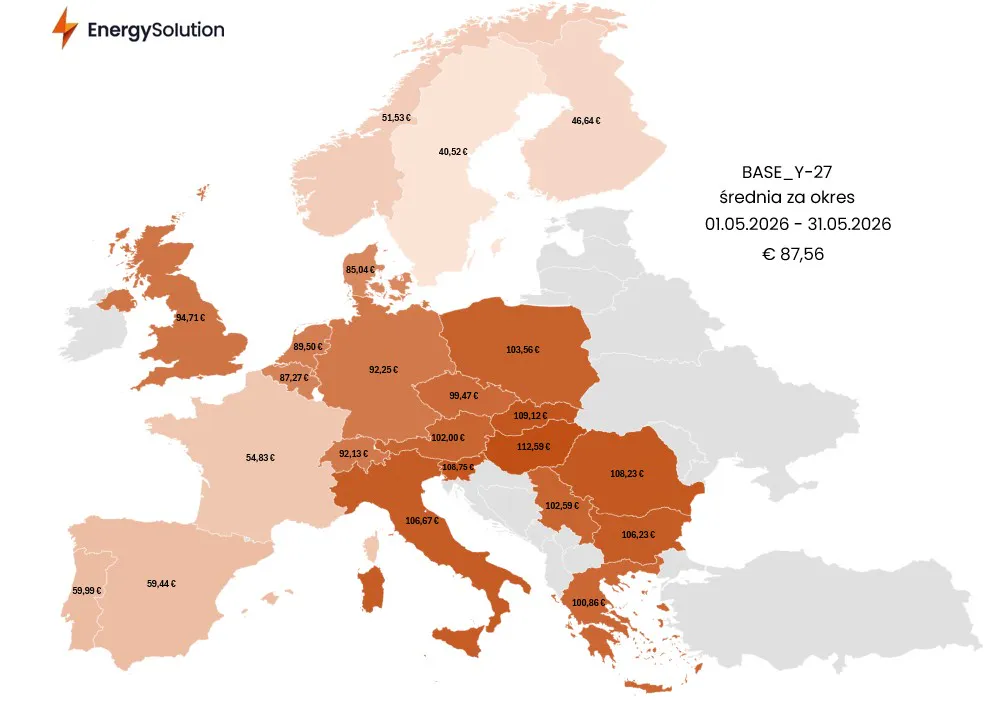
Fig. 2: Average BASE Y-27 price in May 2026
The forward electricity market price, represented by the annual contract for 2027 for the entire analyzed area, averaged EUR 87.56/MWh—an increase of EUR 2.11/MWh (2.5%) compared to April. The main driver behind this rise was the cost of carbon emission allowances (EUAs), which increased by as much as 9.3% month-on-month during the same period. On the other hand, this appreciation was partially offset by falling gas prices—the 2027 annual contract for the TTF benchmark declined by 3.5%.
EUA market accelerates ahead of the EU reform
EUA prices experienced an exceptionally dynamic month. For most of May, they moved relatively steadily within a 1.5‑month sideways trend, fluctuating between EUR 72–77/t. However, toward the end of the analyzed period, prices began to rise more sharply and ultimately broke above the upper bound of this consolidation.
The EUR 80/t level was not breached by the demand side, and early June brought a downward correction toward around EUR 77/t. Pressure stemming from uncertainty related to the upcoming revision of the EU ETS, scheduled for mid-July, remains evident.
On 28 May, seven additional EU countries publicly criticized, during a meeting of competitiveness ministers in Brussels, the changes to benchmark values proposed by the European Commission for allocating free emission allowances under the EU ETS for industry.
Bulgaria and Slovakia joined the position prepared for the meeting by Czechia, Greece, Poland, and Romania, which expressed concerns that the proposed changes for 2026–2030 would harm industrial competitiveness. At the same time, ministers from Estonia, France, Hungary, Italy, and Spain also declared that they shared these concerns.
On the other hand, Germany joined Denmark, Finland, the Netherlands, and Sweden in defending the ETS system.
Additionally, the European Commission recently announced that the Market Stability Reserve (MSR) of the EU ETS will remove 190 million CO₂ emission allowances from scheduled auctions between September 1 of this year and August 31 of next year. This reduction—resulting from an automatic mechanism designed to counteract the impact of surplus supply on prices—corresponds to 19% of the total number of allowances in circulation (TNAC) as estimated by the European Commission.
Geopolitical tensions remain a key factor for the gas market
On the gas market, geopolitical factors continued to play the dominant price-setting role. Despite the ceasefire holding for most of the analyzed period, the Strait of Hormuz was not fully reopened. Moreover, in mid-May, the United States and Iran exchanged accusations after rejecting each other’s peace proposals, and President Donald Trump stated that the ceasefire was “on the verge of collapse.”
The second half of the month was calmer, and short-term factors such as mild weather and the first signs of heatwaves in Western Europe kept prices at lower levels. On the other hand, a decline in LNG flows to Europe could still be observed. Maintenance work in Norway, the persistently unfavorable TTF-JKM spread, and the announcement of an upcoming El Niño weather pattern also did not help.
Following a meeting of the Oil and Gas Coordination Group, the European Commission recently announced that EU gas storage levels could reach 80% before winter, despite the ongoing conflict in the Middle East. The group confirmed that there are currently no immediate concerns regarding the security of gas supplies in the EU for the upcoming winter season. However, it was noted that the storage filling process must be regularly assessed in light of evolving developments. Currently, the average level of gas storage in the EU stands at 43%.
Decline in oil prices amid a growing deficit
Due to relatively stable supply conditions in the oil market (despite the closure of the Strait of Hormuz), the price of Brent crude fell by 8.9% month-on-month and remained around USD 90/bbl.
Unfortunately, according to the IEA’s monthly report, global observed oil inventories declined in March and April at a rate of around 4 million barrels per day. According to the IEA, the market will remain “severely undersupplied” at least until October, even if the conflict ends next month.
Increase in coal prices amid rising demand
Recently, we have observed a reversal of the trend in the coal market, which has reached its highest levels in two months. The increase in prices is driven by higher demand (mainly from China) and the announcement of export restrictions by Indonesia following the implementation of a new centralized export system aimed at improving state budget revenues.